
I'm available for business trips to other cities for projects lasting a month or longer.
- Main
- Abstract
- Introduction
- Konnex SubNet Architecture
- Experimental Results & Benchmarks
- Design Overview
- Vision-Language-Action Models in Konnex
- How VLA Models Work in Konnex
- Universal Home Robotics with PI0.5
- Simulation Testing
- Konnex Simulation-to-Real Pipeline
- Key Benefits for Konnex Network
- Proof-of-Physical-Work (PoPW)
- Example Contract
- Stablecoin-Native Settlement
- Protocol Architecture
- Research & Results
- Performance Analytics & Insights
- PoPW Verification in Simulator
- Task Submission → Finality: End-to-End Performance
- ELO Rating & Miner Specialization
- Task Routing Pipeline: From Intent to Specialized Execution
- Confidence: Calibrated Probability of Finality
- Task Lifecycle Flow
- Validator Consensus Mechanism
- Reward Distribution Flow
- AI Model Competition Arena
- Reward Distribution Flow
- Conclusion


Konnex: Robots Driven by AI Agents
Trustless Cross-Robot Contracts, Decentralized AI Providers, and Validator-Verified Proof-of-Physical-Work

Abstract
Konnex is the permissionless market for robotics autonomous AI agents and verified physical work — a single on-chain fabric with stablecoin settlement where AI agents controlling robots sign trust-less contracts, command robotic hardware to compete for work, and use services of specialized decentralized Robotic AI Providers.
By combining a low-latency mesh network, collateral-backed smart contracts, validator-verified Proof-of-Physical-Work (PoPW), and stablecoin-native settlement — while keeping security, governance, and network fees in KNX — Konnex creates the economic substrate for a permissionless agent-driven economy of physical work.
Introduction
Konnex begins with a simple observation: most consumer‑grade robots already possess excellent hardware, yet they still lack the autonomous intelligence and "communication skills" needed for real‑world tasks.
Manufacturers do not embed autonomous AI models, and robots cannot chain their efforts together. A kitchen arm can grip a pan, a delivery drone can lift a parcel, but each arrives "empty‑headed"—unable to allow an AI agent to transform a plain‑English request into safe, efficient action.
It is like an alien with a perfect body and an IQ = 900 who nevertheless knows nothing about our world and cannot collaborate with people or sign agreements.
Meanwhile, hundreds of research teams are building sophisticated analytical and AI solutions for diverse robotic environments, but they have no incentive to share these solutions (e.g., through public APIs) because there is no clear way to monetize them. Robots themselves cannot help one another either: the kitchen robot cannot ask the delivery robot to fetch ingredients for soup.
Konnex connects every robot to a decentralized Robotic‑AI Network in which every task is broadcast to AI miners; the best behavioral policy (model) is deployed to the robot, and multiple robots can collaborate by signing Proof‑of‑Physical‑Work (PoPW) smart contracts that settle natively in stablecoins—entering agreements with one another to jointly solve complex tasks, just as humans do.
The robotics economy scales only with a natively embedded, non‑volatile settlement currency. On Konnex this role is fulfilled by stablecoins: every task, escrow, penalty, and reward settles in stablecoins by default.
Manufacturers do not embed autonomous AI models, and robots cannot chain their efforts together. A kitchen arm can grip a pan, a delivery drone can lift a parcel, but each arrives "empty‑headed"—unable to allow an AI agent to transform a plain‑English request into safe, efficient action.
It is like an alien with a perfect body and an IQ = 900 who nevertheless knows nothing about our world and cannot collaborate with people or sign agreements.
Meanwhile, hundreds of research teams are building sophisticated analytical and AI solutions for diverse robotic environments, but they have no incentive to share these solutions (e.g., through public APIs) because there is no clear way to monetize them. Robots themselves cannot help one another either: the kitchen robot cannot ask the delivery robot to fetch ingredients for soup.
Konnex connects every robot to a decentralized Robotic‑AI Network in which every task is broadcast to AI miners; the best behavioral policy (model) is deployed to the robot, and multiple robots can collaborate by signing Proof‑of‑Physical‑Work (PoPW) smart contracts that settle natively in stablecoins—entering agreements with one another to jointly solve complex tasks, just as humans do.
The robotics economy scales only with a natively embedded, non‑volatile settlement currency. On Konnex this role is fulfilled by stablecoins: every task, escrow, penalty, and reward settles in stablecoins by default.
Konnex SubNet Architecture
The Konnex network operates as a permissionless marketplace where AI miners compete, validators verify, and robots execute —
all coordinated through decentralized subnets with stablecoin settlement.
all coordinated through decentralized subnets with stablecoin settlement.

Experimental Results & Benchmarks
Table I:
Model Card in Konnex — Production Readiness
Comprehensive comparison of open-source VLA models evaluated within the Konnex environment. This table assesses production readiness by measuring inference efficiency, safety, and verifier agreement. All models tested on identical Konnex task suites with consistent evaluation protocols.
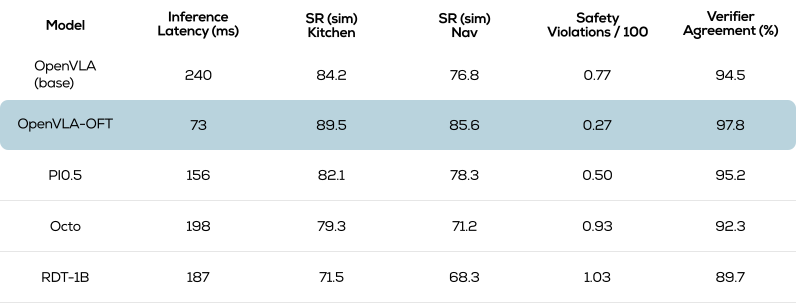
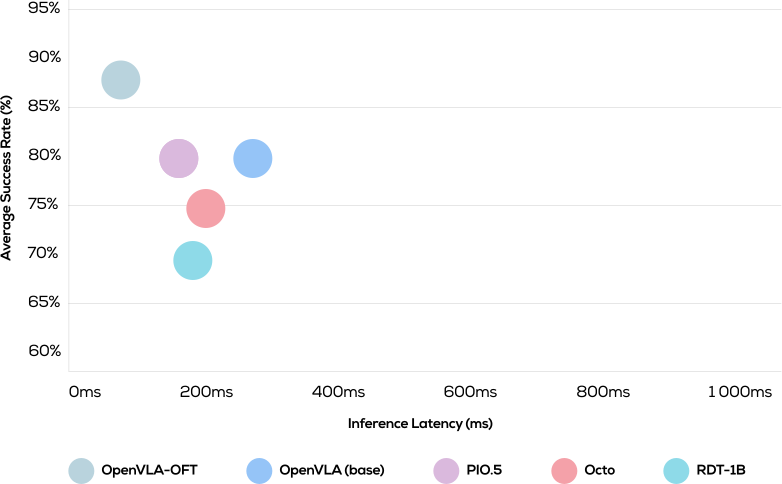
Table II:
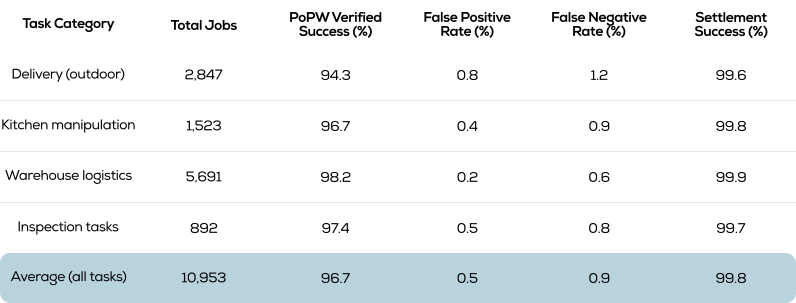
Proof-of-Physical-Work Verification Accuracy
PoPW validation results across different task types and environments. Validators verify execution using sensor logs (GPS, camera, IMU, torque). Settlement success measures correct stablecoin release/penalty application.
Note: Results from 6-month TestNet deployment across 4 validator nodes. Settlement success >99.5% demonstrates reliable stablecoin escrow and release mechanism.
Design Overview
Konnex is powered by a single decentralized validator network that tackles two key challenges:
Universal Communication & Robot Smart-Contract Protocol
A peer-to-peer mesh that normalizes task grammar, robot identity, and collateral-backed commitments. Validators verify execution through Proof-of-Physical-Work (PoPW) and trigger native stablecoin escrow settlement so every inter-robot contract is honored on-chain.
- Resilient Mesh Network: Low-latency QUIC/libp2p transport delivers messages in milliseconds
- Cross-Robot Smart Contracts: Any robot can sign on-chain deals with stablecoin escrow
- Proof-of-Physical-Work: Sensor logs verified by independent validators
Incentive-Driven Robotics-Intelligence Marketplace
A trust-layered, decentralized AI exchange that brings robot owners and AI-developer teams together under validator oversight. Robo-AI miners stake collateral, propose control-policy roll-outs, and earn trust-weighted rewards scored by independent validators, with payouts settled in stablecoins.
AI Miners: Compete to provide best policies for tasks
Validators: Score policies and verify execution
Users: Submit tasks and automatically get best solutions
AI Miners: Compete to provide best policies for tasks
Validators: Score policies and verify execution
Users: Submit tasks and automatically get best solutions
Vision-Language-Action Models in Konnex
Konnex integrates multiple state-of-the-art Vision-Language-Action (VLA) models as the "brains" for robotic tasks. These models enable robots to understand natural language instructions and translate them into physical actions.
7B parameters · 970k robot episodes
OpenVLA is an open-source 7B parameter VLA model pretrained on the Open X-Embodiment dataset. It serves as a strong base layer that can be adapted to different robots and tasks.
OpenVLA
Zero-shot generalization
Multi-robot support
Parameter-efficient fine-tuning
OpenVLA-OFT uses Optimized Fine-Tuning (OFT) to efficiently adapt OpenVLA to new domains. It achieves 25-50x faster inference and 20%+ boost in success rate compared to base OpenVLA.
OpenVLA-OFT
97.1% LIBERO success
25-50x faster
Open-world generalization
PI0.5 exhibits meaningful generalization to entirely new environments through co-training on heterogeneous data sources, enabling robots to work in unseen homes and settings.
PI0.5
New environment adaptation
Semantic understanding
How VLA Models Work in Konnex
Task Broadcast
User submits natural language task
1
AI Miners Compete
Multiple VLA models generate candidate policies
2
Simulation Gate
Validators test policies in 3D physics simulator
3
Deployment
Best policy deployed to real robot
4
PoPW Verification
Validators verify execution and settle in stablecoins
5

Universal Home Robotics with PI0.5
Konnex integrates PI0.5, a cutting-edge VLA model capable of performing diverse household tasks autonomously. These demonstrations showcase the versatility of policies deployed through the Konnex network.
Why Universal Home Robotics Matters
In the Konnex ecosystem, robots must handle a wide variety of real-world tasks without task-specific programming. PI0.5 demonstrates this capability by generalizing across manipulation tasks in home environments:
- Dexterous manipulation — Handling delicate objects like towels and plates
- Multi-step tasks — Complex sequences like making beds and organizing items
- Spatial reasoning — Understanding 3D environments and object placement
- Adaptive control — Adjusting to different object properties and configurations
Hanging Towel
Precise cloth manipulation and spatial placement. The robot grasps the towel, maintains tension, and positions it accurately on the rack — demonstrating fine motor control and understanding of deformable objects.
Making Bed
Multi-step household task requiring coordination. The policy sequences multiple actions: straightening sheets, arranging pillows, and adjusting blankets — all from a single high-level instruction.
Drying Plate
Careful object handling with tool use. The robot coordinates wiping motion with secure grip, then precisely places the plate on the dish rack — showing awareness of object fragility and stability requirements.
Organizing Drawer
Spatial organization and multi-object manipulation. The policy determines optimal placement for multiple items, handles different object shapes, and arranges them neatly — demonstrating planning and execution skills.
Simulation Testing
Before deploying AI models to real robots, Konnex uses a powerful GPU-parallelized robotics simulation platform — to safely test and validate policies in diverse virtual environments. This simulation-first approach is a cornerstone of our Proof-of-Physical-Work verification system.
Why Simulation Testing Matters in Konnex
In the Konnex network, when AI miners submit candidate policies for a task, validators must verify that these policies are safe, efficient, and accomplish the stated goal before they touch any physical hardware. Simulation Testing enables validators to:
- Run deterministic replays — Re-simulate trajectories byte-for-byte with seeded physics
- Test at scale — GPU parallelization allows testing thousands of scenarios simultaneously
- Validate safety — Catch dangerous behaviors (collisions, torque limits, unsafe trajectories) in simulation
- Benchmark performance — Measure success rates, speed, and efficiency across diverse tasks
- Enable fair competition — All AI miners are evaluated in identical simulated conditions
High-Fidelity Physics Simulation
Simulator provides photorealistic rendering and accurate physics simulation. Konnex validators use these environments to execute AI-miner policies and verify their behavior before deployment. Every policy must pass simulation gates to be considered for real-world execution.
Diverse Manipulation Tasks
Using Simulator, Konnex validators can test policies across hundreds of manipulation tasks — from pick-and-place to assembly, from pouring liquids to opening drawers. This diversity ensures that AI miners must build robust, generalizable policies to win competitions.

Konnex Simulation-to-Real Pipeline
AI Miners Submit Policies
Multiple AI developers compete by submitting candidate control policies
1
Simulation Gate
Validators test all policies in identical simulated environments
2
Performance Scoring
Policies ranked by success rate, safety, speed, and efficiency
3
Winner Selection
Best policy selected for real-world deployment
4
Real Robot Execution
Winning policy deployed to physical robot with PoPW verification
5
Key Benefits for Konnex Network
Fast Validation
GPU parallelization enables testing hundreds of policies in seconds, not hours

Safety First
Catch dangerous behaviors in simulation before they can damage real hardware

Fair Competition
All AI miners evaluated under identical conditions with deterministic physics

Cost Effective
Test millions of scenarios without wear-and-tear on physical robots

Proof-of-Physical-Work (PoPW)
Konnex lets robots make clear, on-chain deals with each other just like people do. All contracts escrow and settle in stablecoins (stable dollar); network fees and governance remain in KNX.
Lock
LoPayer funds an on-chain stablecoin escrow for the taskck
Perform
Executor records sensor evidence (GPS, camera, IMU, torque, temperature)
Prove
Executor submits a PoPW bundle referencing the JobID and deadline
Verify
Independent validators review the bundle and publish a ScoreRoot
Settle
On pass, escrowed stablecoins are released; on fail, penalties applied
Example Contract

Stablecoin-Native Settlement
Konnex is a robot-native network where every task, escrow, penalty, and reward settles in stablecoins by default. Stablecoins provide a predictable, dollar-denominated cash leg for machine commerce, while KNX remains the core network token for validator security, governance, and protocol fees.
Stablecoins
Settlement currency for contracts
Contract Settlement Types
- Fixed-price: Single stablecoin amount escrowed and released on successful proof
- Metered: Usage-based charging (seconds, meters, frames) with continuous stablecoin debits
- Milestone: Staged releases of stablecoins across multiple checkpoints for long-running jobs

Escrow, payouts, penalties
Financial collateral
Card on/off-ramps
Cross-chain liquidity
KNX
Validator staking and slashing
Protocol governance
Network fees
Buyback/treasury mechanism
Security layer
Protocol Architecture
The Konnex stack is a layer-cake where communication, contracts, intelligence, and motion align like clockwork. Every step of a task—broadcast, bidding, execution, proof, payout—flows through four deterministic layers and one economic loop.
ibp2p + QUIC, NAT-friendly, always-on
task.*
— signed JSON intents
bid.*
— bids with ETA and collateral
score.*
— validator ScoreRoot
proof.*
— validator ScoreRoot
Layer 0 · Mesh & Gossip
RobotIdentity
— hardware-secured keys and trust score
TaskRegistry
— stablecoin escrow, deadlines, penalties
StakeVault
— dual staking (KNX + stablecoins)
BondMatrix
— stablecoin bonds from third-party stakers
PayoutRouter
— atomic release of stablecoins
Layer 1 · Registry & Smart Contracts
Layer 2 · Intelligence & Motion Markets
- Motion Miners: Generate trajectories in deterministic sandbox
- AI Miners: Supply perception/planning policies as WASM weights
- Miners declare KPIs, stake KNX, and may post stablecoin bonds
Layer 3 · Verification & PoPW
- Deterministic Replay: Re-simulate trajectories byte-for-byte
- Model Audits: Benchmark inference against ground-truth
- PoPW Check: Verify sensor bundle completeness and time-alignment
- Slash / Reward: Write ScoreRoot; release stablecoin escrow or apply penalties
Validator Council, Wasmtime Replay
Research & Results
Our research demonstrates the feasibility of a permissionless robotics AI marketplace. We have integrated multiple VLA models and connected them with an AI-Verifier layer to create a working system for decentralized robotic intelligence.
VLA Model Integration
Successfully onboarded 3 VLA starting points:
- OpenVLA (no fine-tune)
- OpenVLA · OFT (parameter-efficient finetune)
- PI-0.5
AI-Verifier System
Vision LLM (GPT-Vision mini-style) produces strict JSON metrics from frames + instruction. The verifier layer remains pluggable, allowing different scorers to be swapped or combined.
Simulation-to-Real Pipeline
3D physics simulator used for safe rollouts and test iterations. Policies are validated in simulation before deployment to real hardware.
Multi-Miner Competition
When a user sends a task, it is broadcast to multiple AI-Miners; each miner returns a candidate trajectory/video. AI-Verifiers then score each result and select the best one.
PoPW Verification in Simulator
Task Submission → Finality: End-to-End Performance
Table VI:
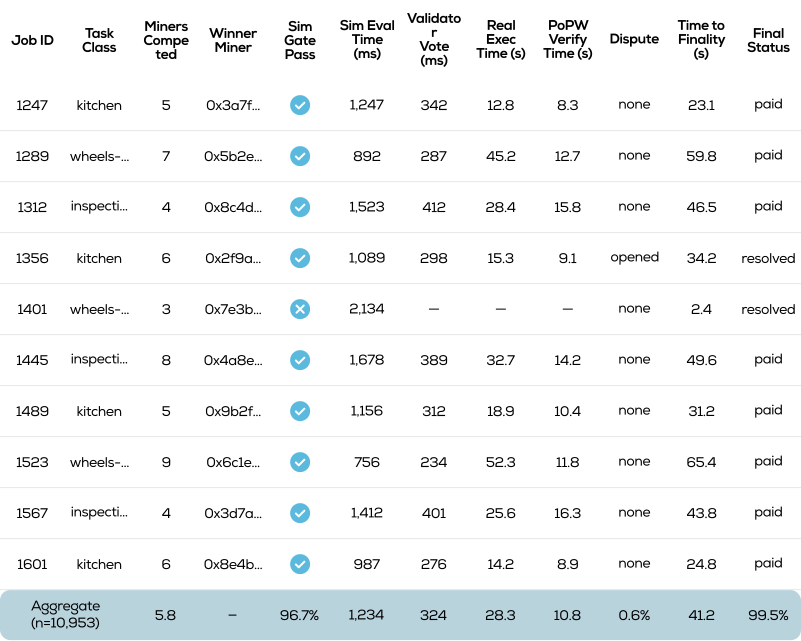
Job Trace — Representative Task Lifecycles
Detailed trace of individual tasks through the Konnex network, from submission to final settlement. Each row represents a complete job lifecycle with timing metrics at each stage. Representative examples shown above, aggregate statistics below.
Time Breakdown by Stage — Waterfall Analysis
Cumulative time decomposition across task lifecycle stages for different task classes. Each bar segment represents time spent in a specific stage (Broadcast, Bidding, AI-Mining, Sim eval, Validator consensus, PoPW verify, Settlement finality). Lower total height indicates faster end-to-end execution.

Time Distribution by Stage — Cumulative Distribution Function (CDF)
Cumulative distribution of execution time for each lifecycle stage. Each curve shows the percentage of stage executions completed within a given time. Steeper curves indicate more consistent stage performance. Stages are based on waterfall analysis data.

Complete lifecycle analysis of tasks from submission to stablecoin settlement. This section demonstrates how Konnex functions as both a permissionless marketplace and a validator-verified court, ensuring transparent, efficient task execution with predictable finality.
Note: Representative examples from 6-month TestNet deployment. Aggregate statistics computed over 10,953 completed jobs. Time to finality measured from task submission to stablecoin settlement confirmation. Dispute rate <1% demonstrates robust validator consensus.
These metrics demonstrate Konnex's efficiency as a dual-purpose system: a competitive marketplace for AI policies (miners compete, best wins) and a cryptographic court for physical work verification (validators verify, stablecoins settle). The median time-to-finality of 41.2 seconds across all task classes, with 99.5% successful settlement rate, validates the scalability and reliability of the permissionless robotics AI network.
ELO Rating & Miner Specialization
Table VII:
Miner Leaderboard by Category
Comprehensive performance metrics for AI miners across different task categories. ELO ratings use TrueSkill (μ/σ) format. Recent delta shows 7-day performance change. Specialization patterns emerge as miners focus on categories where they achieve highest win-rates.
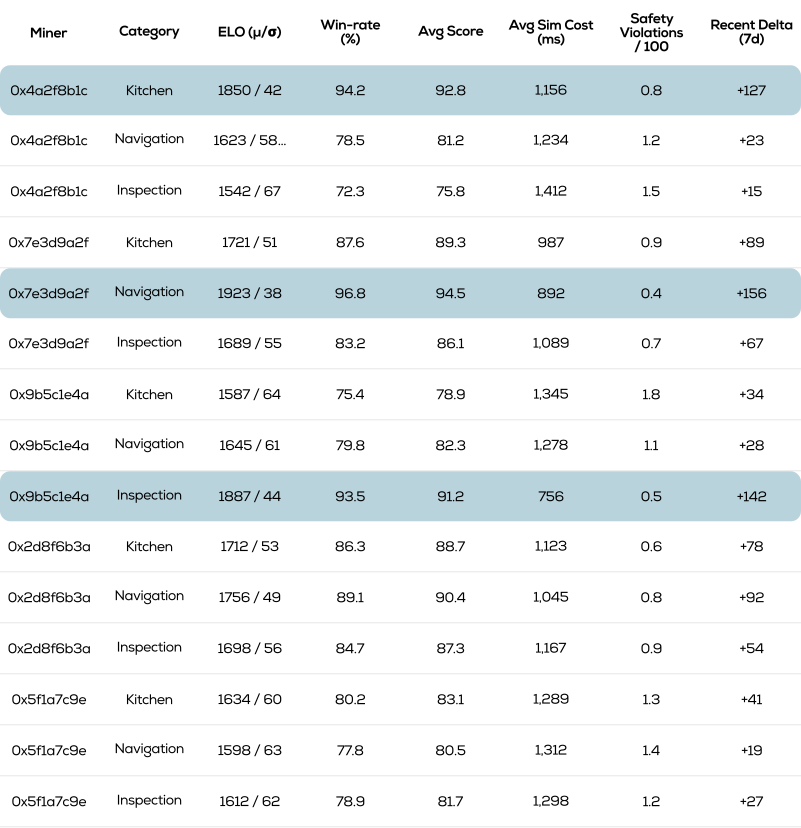
This section demonstrates how AI miners specialize and improve through fine-tuning on Konnex datasets. The ELO rating system tracks miner performance across different task categories, revealing specialization patterns and the impact of fine-tuning on model capabilities.
Note: ELO ratings use TrueSkill format (μ = mean skill, σ = uncertainty). Lower σ indicates higher confidence. Specialization is evident: 0x4a2f8b1c excels in Kitchen (94.2% win-rate), 0x7e3d9a2f dominates Navigation (96.8%), and 0x9b5c1e4a leads in Inspection (93.5%). Recent delta shows performance improvements after fine-tuning on Konnex dataset v2.1.
Task Routing Pipeline: From Intent to Specialized Execution
The Konnex routing system transforms a high-level task intent into execution by a specialized AI miner. Each stage filters and refines the candidate set, ensuring optimal miner selection based on confidence, specialization, and performance history.
Task Intent
Text + Context
Context: home environment, safety constraints
"Clean the kitchen countertop"
Task Classifier
Predict Category + Constraints
Category: Kitchen
Constraints: Safety level: high. Time limit: 5min
Constraints: Safety level: high. Time limit: 5min
Candidate Miners Set
Top-K by Eligibility
K=5 selected from 47 eligible miners
0x4a2f8b1c (ELO: 1850, Kitchen)
0x7e3d9a2f (ELO: 1721, Kitchen)
0x2d8f6b3a (ELO: 1712, Kitchen)
0x7e3d9a2f (ELO: 1721, Kitchen)
0x2d8f6b3a (ELO: 1712, Kitchen)
Sim Gate + Scoring
ManiSkill Evaluation
0x4a2f8b1c: 94.2% success, 1.2s avg, 0.8 safety violations
0x7e3d9a2f: 96.8% success, 0.9s avg, 0.4 safety violations
0x7e3d9a2f: 96.8% success, 0.9s avg, 0.4 safety violations
Winner Policy
Selected Specialist
Confidence: 0.94 | ELO: 1923 | Category: Kitchen
0x7e3d9a2f
(PI0.5 fine-tuned on Kitchen v2.1)
(PI0.5 fine-tuned on Kitchen v2.1)
PoPW + Settlement
Verification & Payment
PoPW verified: ✓
Reward: 20 USDC → 0x7e3d9a2f
Stakes returned: ✓
Reward: 20 USDC → 0x7e3d9a2f
Stakes returned: ✓
Confidence: Calibrated Probability of Finality
Confidence = f(p_sim, p_popw, skill, ood)
p_sim_success
Probability of success in simulation tests (evaluation)
Range: [0, 1] | Weight: 0.35
p_popw_pass
Probability of passing PoPW verification based on evidence template matching
Range: [0, 1] | Weight: 0.30
miner_skill
Normalized ELO rating by category (TrueSkill μ normalized to [0, 1])
Range: [0, 1] | Weight: 0.25
ood_risk
Out-of-distribution uncertainty / novelty score (lower = better)
Range: [0, 1] | Weight: 0.10 (inverted)
In Konnex, confidence is not a single metric but a calibrated probability of finality — the probability that a selected miner will successfully complete the task and pass PoPW verification. Confidence is computed as a weighted combination of multiple signals:
Calibration: Confidence scores are calibrated against empirical success rates (see Calibration Chart). A confidence of 0.94 means 94% of tasks with this score succeed in practice.
Table VIII:
Routing Accuracy & Efficiency
Performance metrics for the Konnex routing system across different task categories. Top-1 match measures how often the router selected the miner who actually performed best. Top-3 coverage shows the percentage of cases where the best miner was in the top-K candidate set. Compute budget measures the cost of finding the optimal miner.
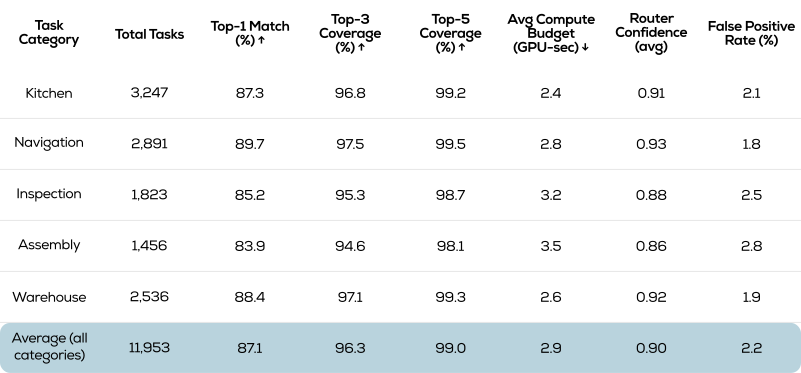
Note: Top-1 match of 87.1% means the router selected the best-performing miner in 87.1% of cases. Top-3 coverage of 96.3% indicates that the optimal miner was included in the top-3 candidate set 96.3% of the time, demonstrating effective filtering. Average compute budget of 2.9 GPU-seconds per task shows efficient routing with minimal computational overhead. False positive rate measures cases where a high-confidence prediction failed (confidence > 0.8 but task failed).

User Request
Submit task + escrow USDC

Task Analysis
Parse requirements & constraints

AI Miner Auction
Miners submit policies + stakes

Simulation Gate
Tests all policies

Validator Vote
Consensus on best policy

Robot Execution
Deploy winner to real robot

PoPW Recording
Capture sensor logs & video

Validator Verification
Verify PoPW authenticity

Settlement
Distribute rewards in USDC
Task Lifecycle Flow
Every task in Konnex follows a deterministic path from user request to verified completion, ensuring transparency and trust at every stage.
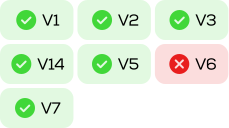
Validator Consensus Mechanism
Validators in Konnex form a Byzantine Fault Tolerant consensus layer, requiring 2/3+ agreement on simulation results and PoPW verification.
- Slashing Protection: Disagreeing validators risk losing stake if proven wrong
- Replay Verification: Any validator can re-run simulations deterministically
- Reputation Weighting: High-reputation validators have higher voting power
Input Layer
📦 Policy Checkpoint
🎲 Simulation Seed
📹 PoPW Evidence
🎲 Simulation Seed
📹 PoPW Evidence
Validator Network
Output Layer
🏆 Winner Selection
💸 Reward Distribution
📊 Reputation Update
💸 Reward Distribution
📊 Reputation Update
Reward Distribution Flow
Stablecoin-native settlement ensures instant, predictable rewards for all network participants.
- Instant Settlement: All rewards distributed in a single transaction (4.1s average)
- Failed Tasks: If PoPW verification fails, escrow refunded to user minus gas
- Penalty Pool: Slashed stakes from dishonest actors redistributed to validators
Task Escrow
User-deposited reward
100 USDC
60%
Winning AI Miner
60 USDC
+ stake returned
25%
Validators
25 USDC
Split by voting power
10%
Robot Operator
10 USDC
Hardware & electricity
5%
Protocol Treasury
5 USDC
Development & maintenance
AI Model Competition Arena
Multiple AI miners compete simultaneously for each task, with the best-performing policy winning the reward.
Competition Results
0x7e3d9a2f (PI0.5 Custom) wins with score 95.2
✓ Winner receives: 60 USDC + stake returned
✓ Runners-up: stakes returned
✓ Policy deployed to robot for execution
✓ Winner receives: 60 USDC + stake returned
✓ Runners-up: stakes returned
✓ Policy deployed to robot for execution
New Task Available
"Organize kitchen countertop"
Reward: 50 USDC
Deadline: 2 hours
0x9b5c1e4a
Custom VLA
Stake: 3 KNX + 8 USDC
Success: 85%
Speed: 9.5s
Safety: 95%
Speed: 9.5s
Safety: 95%
Score: 82.1
0x7e3d9a2f
PI0.5 Custom
Stake: 8 KNX + 15 USDC
Success: 97%
Speed: 6.8s
Safety: 99%
Speed: 6.8s
Safety: 99%
Score: 95.2
0x4a2f8b1c
OpenVLA-OFT
Stake: 5 KNX + 10 USDC
Success: 92%
Speed: 8.2s
Safety: 98%
Speed: 8.2s
Safety: 98%
Score: 89.4
Reward Distribution Flow
Stablecoin-native settlement ensures instant, predictable rewards for all network participants.
40%
Success Rate
Task completion in simulation
30%
Efficiency
Speed & energy consumption
20%
Safety
Collision avoidance & limits
10%
Reputation
Historical performance
Conclusion
Konnex tackles a deceptively simple challenge: robots possess the hands, wheels, and rotors to perform useful work, yet they lack a shared brain — and a shared court — to negotiate, verify, and reward that work at global scale.
What success looks like in 2033 is already sketched:
lunch swarms that self-coordinate, kitchens that license cognition on the fly, and city DAOs that hire anonymous robot crews with the same ease they fund open-source code today — with every outcome settled in stablecoins and every block secured by KNX.
Dollar-first UX, crypto-grade finality.
Stablecoins enable predictable escrows (and optional card on-ramp), while KNX secures consensus, pays fees, and drives the buyback flywheel from a small stablecoin flow fee.
Cryptographic safety nets.
PoPW binds sensor evidence to a JobID and deadline; validators post dual stakes (KNX for protocol security, stablecoins for settlement assurance). Bad behavior is slashed; good performance lowers collateral.
Market-priced intelligence.
Decentralized AI miners compete on every job, turning control software from a sunk R&D cost into a live marketplace where the best model earns trust-weighted income and instant user reach.
One grammar, one ledger, one stable rail.
Any robot, from a countertop arm to a bridge crawler, can express tasks, lock deposits, and settle rewards in stablecoins using the same packet format. What TCP did for bytes, Konnex does for motion.
If you build robots, plug them in and start earning. If you craft control policies, stake them and let the market decide. If you believe transparency and incentives are the missing catalysts for physical AI, help us validate, verify, and govern the network.

Create, Validate, Earn
- Join a global market for physical work and intelligence
- Earn with Proof-of-Physical-Work
- Publish policies to compete & get paid
Copyright 2025 Konnex. All rights reserved.
